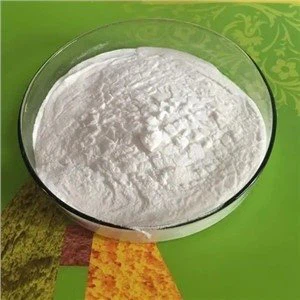

Carob bean gum is a galactomannan. The main chain of the polymer is composed of mannose, and the branch chain is galactose. The ratio of mannose to galactose is 4:1.
Alias: locust bean gum
Classification code CNS 20.023; INS 410
Physical and chemical properties: white or slightly yellow powder, odorless or slightly smelly. It can be completely dissolved in 8 ℃ water to form a viscous liquid. When the pH value is 3.5 ~ 9, its viscosity does not change, but when it is outside this range, its viscosity decreases. Salt, magnesium chloride, calcium chloride, and other solutions have no effect on their viscosity, but acids (especially inorganic acids) and oxidants will cause salting out and reduce their viscosity.
A large amount of calcium salt is added to the alkaline gel solution to form a gel. Adding a small amount of sodium tetraborate to the aqueous dispersion (pH 5.4 ~ 7.0) can also turn into a gel. The milk of Robinia pseudoacacia seeds is baked, extracted with hot water, concentrated, evaporated, dried, crushed, and screened.
Toxicological basis
① LD50: acute oral 13g/kg (BW) in rats.
②GRAS:FDA-21CFR 184.1343。
③ ADI: no regulation is required (fao/who, 1994).
Quality standard
Quality standard GB 29945-2013
① The drying temperature and time are 105 ℃ ± 2 ℃ and 5h respectively.
② The burning temperature and time are 800 ℃ ± 25 ℃ and 3 ~ 4H respectively.
③ The protein coefficient is 6.25.
Application of thickener
GB 2760-2014 stipulates that the maximum dosage of infant formula food is 7.0g/kg. It can be used in all kinds of food (except the food in Appendix 2) according to the production needs.
The reference dosage in food processing, sweet sauce, compound sauce, semi-solid compound seasoning, and the maximum dosage is 5.0g/kg; Candy (including chocolate and its products), the maximum dosage is 25g/kg. (use and limit specified by fao/who (1984): for processing cheese products, 8g/kg; Cream cheese, 5g/kg (used alone or in combination with other thickeners); Casein cheese, 5g/kg (calculated by its cream mixture, used alone or in combination with other stabilizers and carriers); Sardine and its products, mackerel and canned mackerel, 20g/kg (only used in canned soup, alone or in combination with other thickeners and gelling agents);
Canned ready-to-eat baby food 2g/kg; Cream, 5g/kg (used alone or in combination with other thickeners and modifiers, only for pasteurized whipped cream or for ultra-high temperature sterilized whipped cream and sterilized cream); Flavored yogurt and its products after fermentation and heating treatment, 5g/kg (used alone or in combination with other stabilizers); Cold drink, 10g/kg (calculated by the final product, used alone or combined with other emulsifiers, stabilizers, and thickeners, tentative). Use and limit specified by FDA (1989): 0.15% for baked goods; 0.25% for beverages, their base materials, and alcohol-free beverages;
Cheese products, 0.8%; Gelatin, pudding, and stuffing, 0.75%; Jam and jelly, 0.75%. According to the actual production needs, it is not more than 0.5% for all other foods. Sophora bean gum can be used as a thickener with xanthan gum, agar κ- The combination of carrageenan and guar gum can interact to improve its viscosity or form gel. However, before gel action, several kinds of gels should be dissolved first, and then heated to 85 ℃.
By adjusting the mutual proportion of various adhesives, gel with different concentrations can be made. When coexisting with tannic acid, quaternary ammonium salt, and other multivalent electrolytes, precipitates with low solubility are formed, or unstable and useless gel is formed.
Hot Tags: carob bean gum, manufacturers, suppliers, factory, wholesale, custom